

In Poland, a manufacturer of plastic packaging and containers wanted to protect their business against the rising costs of fossil-fuel energy. They also wished to reduce their environmental footprint.
To do so, they reached out to Trane with a request to re-design their existing heating system based on high-efficiency heat pump technology.
During the site visit, the Trane engineering team inspected the four office, production and storage buildings requiring heating. They also examined the two cooling systems already in place, which were operating under different conditions. One was based on a chiller room and dedicated to processes requiring 13-18°C temperatures to work the plastics; the second one was dedicated mostly to processes dealing with oil and based on dry coolers with 25-30°C temperatures. Although these are two completely different systems, they worked perfectly with the Trane City™ RTSF water-to-water heat pumps.
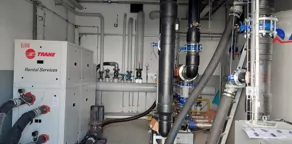
The fossil-fuel based system delivered around 600kW of heating. To replace this and deliver the same amount of heat, Trane engineers divided the heating system into two areas. They installed two Trane City™ RTSF heat pumps – one in combination with the chiller room to deliver 360kW of heating for the space of 9,000m3, and another one to deliver 254kW of heating for 4600m3 in combination with the dry-cooler.
The customer very soon noted the cost savings. In the first set-up, generating the required 360kW of heating with the heat pump unit cost over 25% less – 23EUR per hour vs 33EUR per hour – than the fossil-fuelled system. Additionally, the customer was able to benefit from 223kW of cooling generated by the Trane City™ RTSF unit in the same time.
This additional cooling capacity proved to be crucial when it as used to offset the cooling load suddenly lost when one of the other chillers suddenly broke down.
In the set up with the dry-cooler, generation of 254kW of heating with the heat pump cost the manufacturer over 43% less – 13EUR per hour vs. 23EUR – compared with the fossil-fuel system.
As a result, the customer has not only future-proofed their heating system but is saving money and benefited from the additional cooling capacity that helped them in their emergency.
