

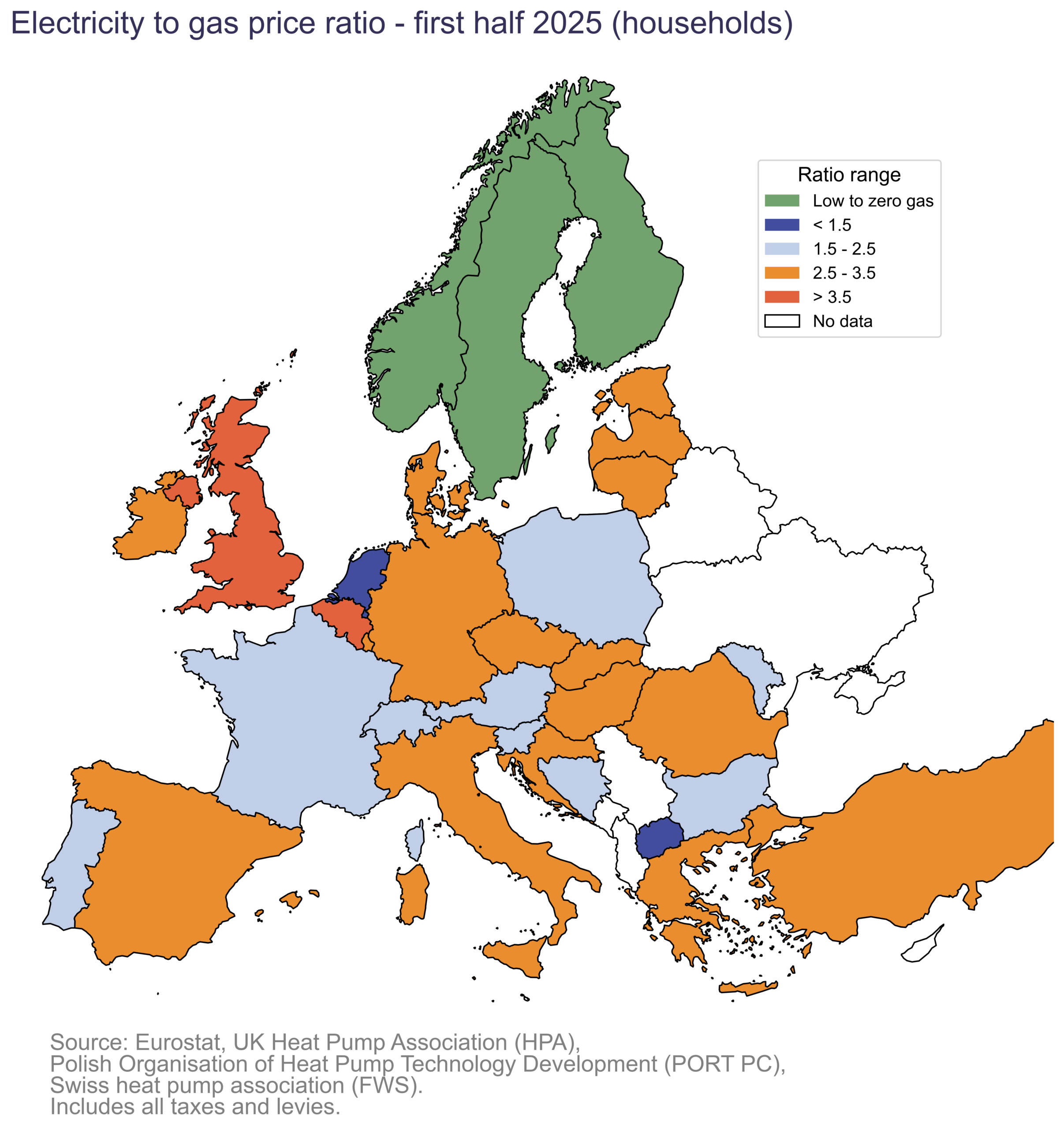
People need to be able to afford to buy their heat pump in the first place – which is why EHPA updated its report tracking national subsidies last year, and continually urges governments not to change or reduce support.
What’s more, heat pump end users need to see a rapid return on their investment, which is closely linked to the taxes governments put on the gas and electricity bills.
In February, the European Commission’s Affordable Energy Action Plan, which accompanied its Clean Industrial Deal, highlighted the importance of reducing electricity bills and remunerating energy grid flexibility. The year was book-ended by the EU’s Affordable Housing Plan in December. Significantly, this plan considers a home’s ‘affordability’ also in terms of energy costs, says affordability should not come at the expense of sustainability, and again repeats that energy bills & taxes must be addressed.
EHPA called and campaigned all year on these issues, showing high energy prices are making it harder for households and businesses to switch from gas to heat pumps through a series of maps and data analysis showing how many countries tax gas far less than electricity. Our message is being listened to, with Germany, The Netherlands, Denmark, The UK, Belgium and Ireland all shifting energy taxes in favour of electricity versus gas.
Another way of making heat pumps competitive is by putting a price on carbon pollution. This is already the case for energy intensive industries and electricity under the EU Emissions Trading System (ETS). The ETS was due to be expanded to buildings and road transport, making heat pumps more competitive compared to fossil fuel heating. However in November, EU governments decided to delay the second ETS for a year to 2028 – a move EHPA described as ‘political posturing’ when rapid implementation of the ETS is key.
EHPA supported its ongoing advocacy work on the ETS2 with a communications campaign including social media videos and an infographic leaflet.
We also put the issue of costs at the heart of the policy debate for EHPA’s members which followed our 2025 General Assembly. Four MEPs and two energy analysts debated decoupling electricity and gas prices, how to ensure everyone can invest in a heat pump, and the future carbon cost of buildings under the EU’s second Emissions Trading System.
One way to ensure everyone can invest in a heat pump is through new business models. One such is ‘social leasing’ or when lower income households can rent a heat pump or clean technologies thanks to public financing. EHPA published a position on social leasing for heat pumps ahead of the expected European Commission guidance on the topic.
Social leasing is a publicly supported scheme that enables low-income households to access clean technologies through affordable monthly rental payments, without the need for upfront ownership.
EHPA believes that social leasing for heat pumps, complementing existing instruments such as grants, reduced VAT rates, and green loans, is a promising solution to overcome high upfront costs and ensure equitable access to clean heating for all.
What’s more, EHPA is involved in research on the topic via a new EU-funded project, HP SUBSCRIBE, which will look into an innovative heat pumps on subscription model. This should open the door for buildings to switch from fossil-fuel boilers to high-efficiency heat pumps with no upfront cost for either landlords or tenants.
Another relevant EU-funded project EHPA is part of is Street HP Reno – which is developing street wide approach for housing for collective switch of energy systems to heat pumps packaged modules. The ultimate goal is to reduce costs and enable the large-scale deployment of heat pumps in renovation projects, serving as a key lever for decarbonising heating in existing housing.
Affirming the importance of addressing costs, the European Commission’s Heat Pump Accelerator Platform – led by EHPA, VITO and Fraunhofer – focused on this in its first position paper, developed at the end of 2025.
As well as focusing on the points mentioned above, the paper says that better use of flexibility is important. This is because heat pumps also become more attractive and affordable when consumers are offered a lower or variable electricity tariff if they switch to a heat pump (see ‘Flexibility’ section).