
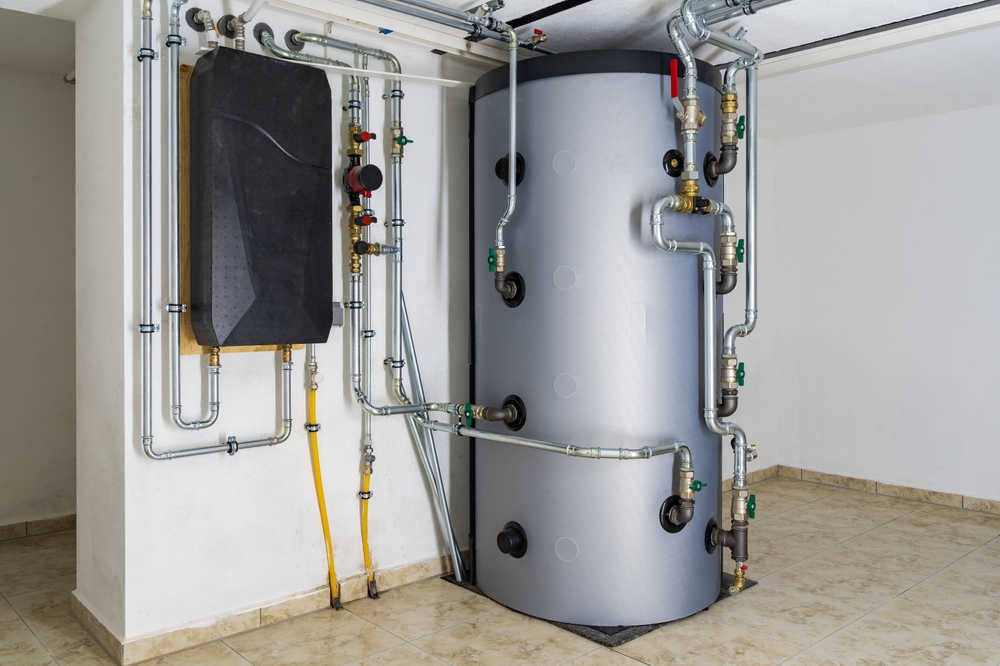
Did you know heat can be stored, produced when it’s cheapest or most efficient, then saved and used later when it’s needed?
Known as ‘thermal energy storage’, this allows more renewable energy to be integrated into the power system – and improves flexibility across industrial and building applications.
During a technical webinar on 10 December 2025, experts from several leading research institutions showed progress across different EU projects.
Their work shows how thermal energy storage is changing: once just a simple “buffer” (like a big water tank) passively absorbing or releasing heat, it is becoming a smart, managed system (an “active asset”) that uses AI and smart controls to actively shift, balance, and optimize energy use for buildings, grids, and renewables.
The first presentation introduced a technique that uses salt – in its liquid form, it can store huge amounts of heat! Francesca Valentini from National Institute for Nuclear Physics (INFN) shared how sodium hydroxide – or ‘caustic soda’ – can be used with liquid or molten salt to store heat safely above 350 °C. To meet the demands of low-pressure steam generation, the team developed a three-layer steam generator, produced through 3D printing. A tailored thermal-resistance layer acts as a thermal valve that stabilises the interface between molten salt and water, preventing salt solidification while avoiding overheating. Simulations show that this can deliver stable heat transfer under realistic steam conditions, offering a promising pathway for cost-effective decarbonisation of industrial heat. The EU project is called ‘Low-cost molten salt thermal energy storage for industrial processes’.
The discussion then moved to high-temperature metallic phase-change materials (PCMs) – materials used to improve thermal transfer between a hot component and a thermal solution like a heatsink, allowing the hot component to run at a lower temperature. This enables the component to run at a lower temperature whereby increase speed which can provide fast and flexible steam generation. Their use in an industrial brewery setting was presented by Jonas Reinholz from Fraunhofer UMSICHT research institute. Metallic PCMs offer high thermal conductivity and excellent cycle stability above 500 °C, addressing the performance limitations of many conventional salts. Using advanced computer modelling and simpler models, researchers looked at how the heat would be released over time as the PCM turns back from liquid to solid form: the release of heat at a constant temperature, then a cooling down. Experiments show that steam heated to a point of pure vapour (‘superheated steam’ can be supplied within seconds, enabling rapid response to peak demand, improving boiler resilience, and creating opportunities to shift steam generation toward renewable electricity sources. This project is called ‘Industrial Process Steam Supply, Demonstration of an Ultra-Dynamic Thermal Energy Storage System.’
Accurate, real-time monitoring of thermal storage remains a central challenge for enabling TES to function as a controllable asset. Louis Desgrosseilliers from SPF-OST and representing the BEST-Storage project presented results from a new working group set up by the International Energy Agency , which will look at how much “heat” (energy) is stored as a percentage of the system’s total capacity – known as ‘state-of-charge (SoC) determination’. Building on earlier work from the International Energy Agency this subtask examines measurement techniques across sensible, latent, and thermochemical storage systems. Promising methods highlighted during the webinar include thermal expansion measurements, infrared emission analysis, acoustic time-of-flight sensing, electrical resistance measurements, and hybrid “state-observer” models that combine physical equations with measured data. While machine learning is increasingly used to detect complex patterns and correlations, the working group (IEA Task 47) methodology emphasises the need for transparent, hypothesis-driven models that can be deployed reliably on standard industrial control hardware.
The final contribution presented the HYSTORE project, led by Sweden’s KTH Royal Institute of Technology. Researchers Aditya Singh Suswal and Saman Nimali described the how they use use phase change material that integrate a certain type of capsules, known as ‘RT57HC’ with a heat pump to provide compact and flexible thermal storage for buildings. Extensive testing in a controlled lab setting enabled them to track how much heat energy (enthalpy) is stored – up to 45 kWh, which is enough for household heating needs. It can quickly store heat during off-peak times and release it when needed, fitting into a normal daily cycle. They found that the speed of the fluid (flow rate) and its starting temperature affect how well heat is released. The system is currently being installed at the KTH Live-in-Lab, where its performance under real-world conditions, including user-driven heating demand, weather variability, and integrated control strategies, will be assessed.
Taken together, this projects illustrate how far TES innovation has progressed in recent years. Advanced materials, digital monitoring techniques, and real-world demonstration projects are positioning TES as a driver of flexibility, electrification, and decarbonisation. As Europe continues its transition toward a climate-neutral energy system, these developments show that thermal energy storage, whether through molten salts, metallic PCMs, or building-scale PCM units, will play a central role in supporting both industrial performance and system-level resilience.