
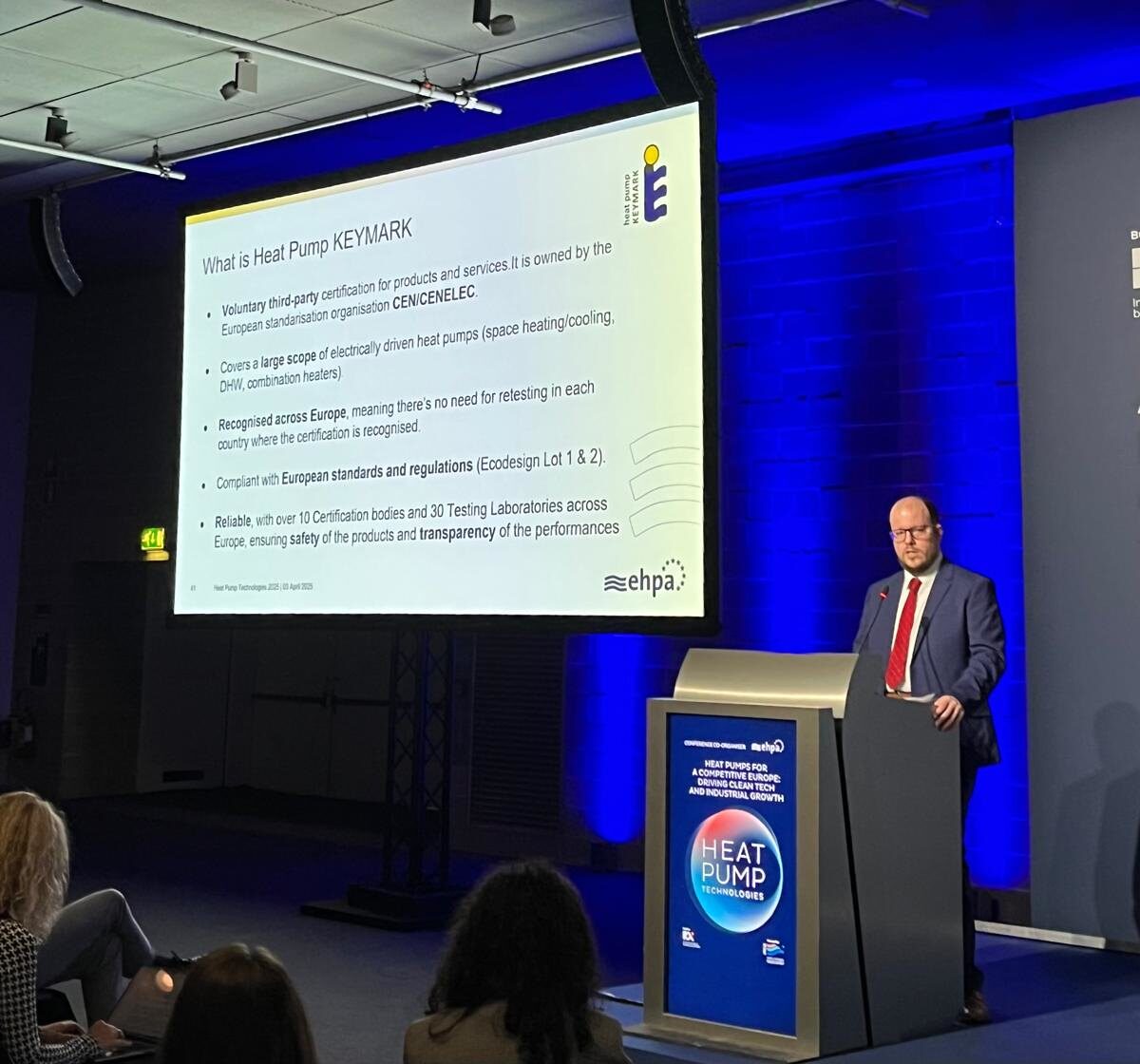
EHPA continues to work on issues related to product design and innovation. It hosts the secretariat of the certification scheme Heat Pump KEYMARK, which reached 12,000 certified models in 2025, 31 recognised testing laboratories, and 11 certification bodies granted the right to award certification.
The Heat Pump KEYMARK team were present at numerous events and trade fairs last year alongside EHPA, including Heat Pump Technologies in Italy giving a presentation on the benefits of the label, and ISK Sodex in Istanbul.
EHPA also runs the Quality Label certification scheme, which continued to demonstrate stability and an active engagement from the market under the coordination of the association. Overall participation levels remained relatively consistent, reflecting sustained confidence in the scheme, with around 1,774 valid certificates covering approximately 11,257 certified models. This steady performance underlines the continued involvement of manufacturers and stakeholders and confirms the Quality Label’s ongoing relevance as a recognised reference point in the sector.
In EU policy terms, EHPA continued to input to the EU’s energy efficient product design (Ecodesign) and labelling rules, taking part to represent the heat pump sector’s views in European Commission round-tables and relevant meetings, as well as an exchange on energy efficient product legislation with EU Energy Commissioner Dan Jorgenson.
For EHPA, it is key to decide upon and enact updates to Ecodesign rules more quickly so that they are not over-taken by other agendas, and to give the sector time to adapt. We supported our messages via a communications campaign.
More generally, product policy has become very complex. Right now, heat pump manufacturers must navigate multiple EU and national product requirements including those related to Ecodesign, refrigerants and flexibility. These mean they have to repeatedly redesign products and get them certified, which adds technical, manufacturing and administrative burdens and costs. The EU needs to coordinate product requirements and align them strategically, bearing in mind the effect this has on product development cycles and product cost, predictability, heat pump uptake and heating decarbonisation more broadly.
In addition, more and more countries are coming out with local content requirements. This is further damaging the single market, pushing up prices, creating administrative burdens and restricting market availability of certain heat pump technologies.
Another key product design issue for EHPA is that of refrigerants. Historically, heat pumps contained fluorinated gases (F-gases), which have a significant global warming potential. The EU now limits their availability and aims to reduce emissions to one-fifth of 2014 levels by 2030. In response, the heat pump sector is rapidly transitioning towards non-fluorinated refrigerant alternatives wherever this is technically and economically feasible.
In 2025, EHPA worked closely with its members to engage with the European Commission and national authorities on the practical implementation of the revised F-gas Regulation. EHPA coordinated technical input and joint industry positions, including on labelling requirements and rules on placing products on the market, together with partner associations. These actions aimed to ensure that the new rules deliver emissions reductions while maintaining legal certainty, product availability and investment confidence across the sector. The next steps are continued exchanges with policymakers to clarify remaining implementation interpretations.
In parallel, the EU is considering a proposal to restrict more than 10,000 chemical substances under the planned PFAS restriction, some of which are currently used in heat pump technologies. EHPA has consistently argued that, without appropriate safeguards, this proposal could unintentionally undermine EU climate and energy objectives by limiting the deployment of efficient heat pumps before viable alternatives are available. To emphasise this risk, EHPA actively participated in discussions within the Risk Assessment Committee (RAC) and the Socio-Economic Analysis Committee (SEAC) of the European Chemicals Agency, and worked with other European associations to align questions and evidence submitted to regulators during the sessions.
The next steps include preparing a dedicated EHPA position for upcoming SEAC consultation (public consultation will be open for 60-days in spring 2026), contributing data on refrigerant use and alternatives, and engaging further with EU institutions to ensure climate-compatible outcomes.
Read more of EHPA’s annual report 2025:
- Introduction
- A clear policy direction
- Affordability for heat pumps
- Industrial heat pumps and waste heat
- Competitiveness and skills
- Flexibility
- Partnerships, communications and campaigns