
Consistent and ambitious long-term policies show consumers that heat pumps are a wise long-term choice, and so spur investments in Europe’s manufacturing capacity and workforce.
In 2025, the European Heat Pump Association continued to underline the importance of such stable and supportive policies. This includes ensuring national governments implement the EU laws already agreed, such as all the climate and energy directives for 2030, the ‘Fit for 55’ package.
In February, the EU Commission published its Clean Industrial Deal, alongside an Affordable Energy Action Plan. We reacted positively to the Deal’s highlighting of the need for industrial decarbonisation and clean tech manufacturing. These are key to speeding up the transition to clean heating and cooling in homes and industries through heat pumps.
One of our focuses in 2025 was on the benefits of stable policies in terms of Europe’s energy security. We organised a debate in the European Parliament on the topic, hosted by MEP Thomas Pellerin-Carlin. We launched an analysis showing Russian gas import equivalents could be replaced by 14 million heat pumps, supported by an infographic leaflet and social media content.
Energy security was also the focus of our Heat Pump Forum, our major annual conference held in September in Brussels, with over 200 participants and a range of insightful panellists and networking moments.
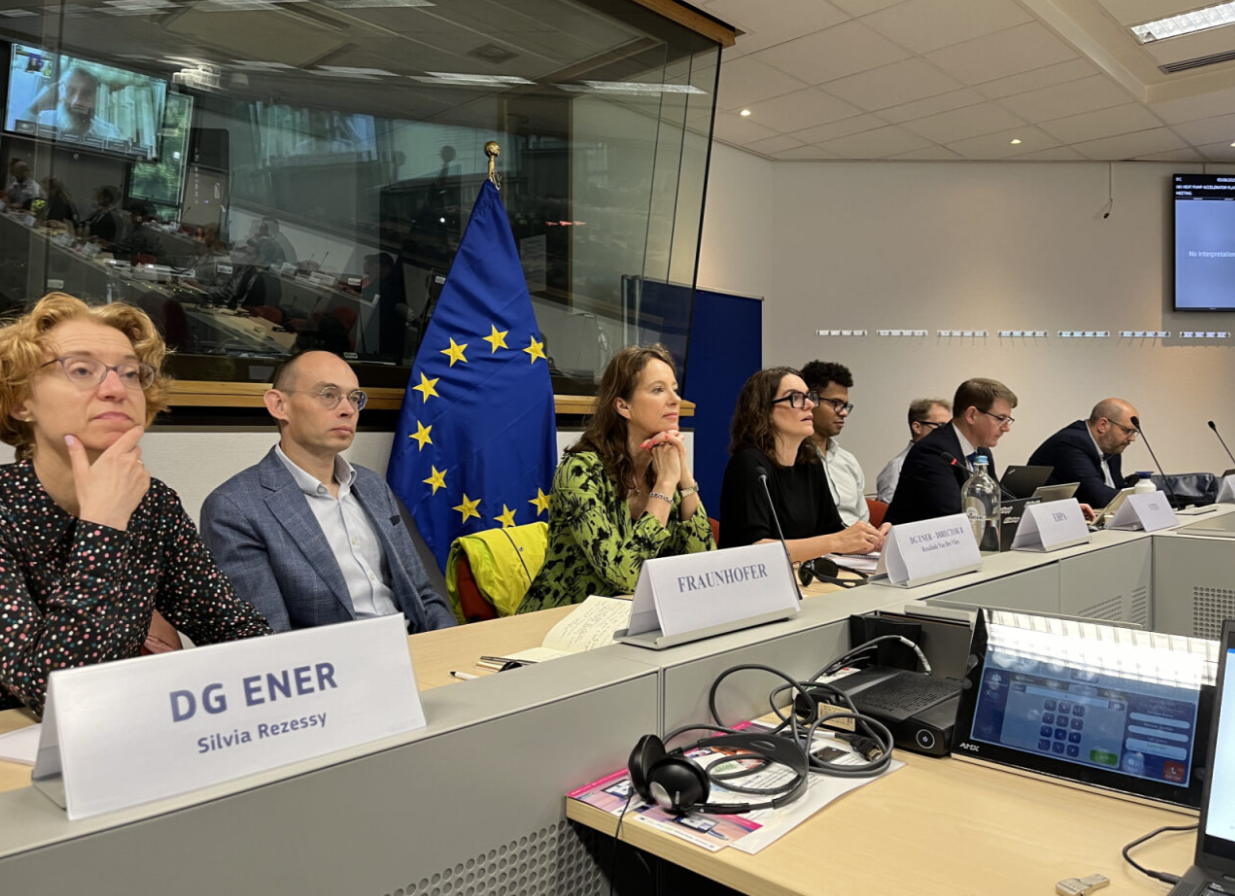
We continued to lead the Heat Pump Accelerator Platform, an initiative from the European Commission which brings government authorities and energy agencies, civil society organisations, utilities, financiers and researchers together. The aim is to share good examples and policies that impact heat pump deployment.
The initiative is co-organised by the European Heat Pump Association, the Belgian research organisation VITO, and the German research institute Fraunhofer ISE for the European Commission.
On a national level, we worked with our national association members to highlight what is taking place to support heat pump rollout, for example by updating our map of fossil fuel boiler bans in Europe.
Further EU initiatives are expected in the early part of 2026 that will support clean industrial competitiveness, electrification, and decarbonisation of heating and cooling. These are the EU electrification action plan, the heating and cooling strategy and the industrial accelerator act. We will continue to deepen our relationships with key policymakers, through closed meetings and targeted events but also through initiatives such as the successful policymaker tour we organised at the ISH heating and cooling trade fair, with members of the European institutions.
Our policy team’s work on the importance of clear, supportive policies is supported by our communications and by a range of EU-funded projects in which we are involved. These include a project helping develop aquathermal energy, WaterWarmth; building digitalisation project Meta build; Shift 2DC on direct current solutions; the RHC project, which has just been extended, on defining a shared strategy for a shift to sustainable heating and cooling and REDI4HEAT on the implementation of the EU Renewable Energy Directive, which came to an end in 2025.
More information on our EU-funded projects, and how they drive innovation and support our policy work can be found here.
Read more of our annual report 2025:
- Introduction
- Affordability for heat pumps
- Industrial heat pumps and waste heat
- Competitiveness and skills
- Flexibility
- Product design, innovation and certification
- Partnerships, communications and campaigns